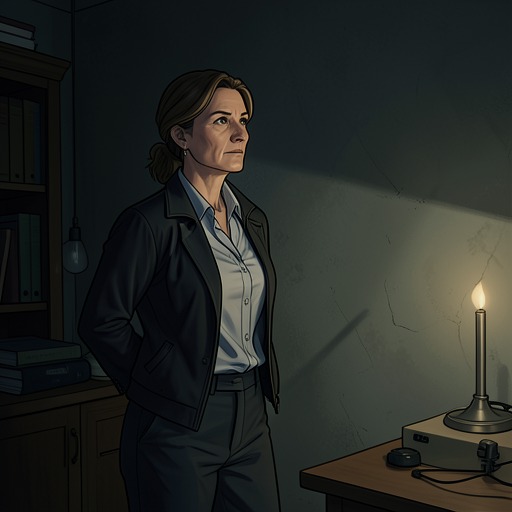
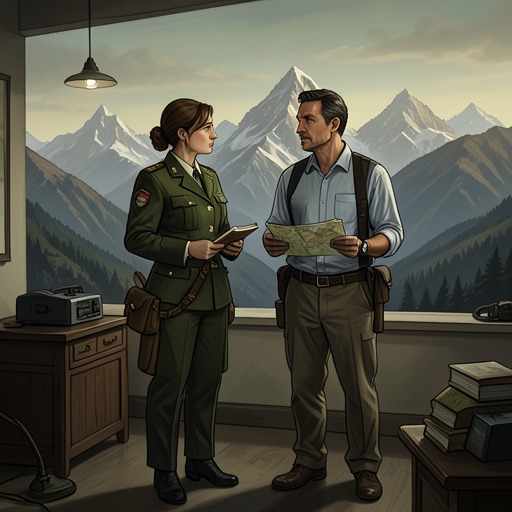
Kristín and Steve’s relationship
Operation NapoleonKristín and Steve’s relationship is shaped by an intimate conflict between personal affection and public stigma: their first attempt at closeness falters under the shame attached to Icelandic women’s relationships with American servicemen, while Elías’s disappearance later draws them back into one another’s confidence. Their reunion does not erase the silence between them, but makes that silence something they can begin to name and reconsider.
Identity and Background
Steve is an American serviceman stationed in Iceland, where he has spent three years working for the base press office. His role is to liaise with Icelandic government ministries dealing with the U.S. military, chiefly the foreign ministry. He lives alone and is divorced; at thirty-five, he is a few years older than Kristín. The narration describes him as lean and strongly built, with dark features and unruly black hair, and recalls that he used to make her laugh.
Their connection begins through official business, then shifts when Steve asks Kristín to dinner. On their first dates in Reykjavík, he tells her about his family and his own choices. His family had always worked in retail, but he was uninterested in business: he studied politics at university and later worked for the U.S. Department of Defense. Travel, rather than either family business or defense work, was his real love, and the opportunity to work in Iceland brought him there. The details make their early conversations an exchange of personal histories, even as the difference between his American military setting and her Icelandic home will become a source of unease.
Attraction, Stigma, and Withdrawal
For their third date, Steve invites Kristín to the officers’ mess on the base and then to his apartment. He is considerate there, but Kristín’s confidence abruptly fails. She panics at the prospect of going to bed with an American on the base, not because Steve has treated her carelessly, but because intimacy carries a public meaning she cannot set aside.
That fear has a specifically Icelandic history. The stigma against women involved with American servicemen reaches back to the Second World War, when some Icelandic women welcomed foreign soldiers as a possible route to a new life overseas, or were drawn to their uniforms, manners, and access to cigarettes, nylons, and good times. The resulting social judgment—known as “the situation”—branded women who slept with servicemen as sluts. Kristín feels that this attitude has changed little. Her hesitation is therefore more than a private uncertainty about one date: it reflects a judgment she expects society to place on her, even in a relationship with a man she likes.
When Kristín tries to explain herself, Steve is hurt that she sees him in those terms. She leaves, and they gradually see less of each other. Their relationship does not end in a clear confrontation or an explicit decision to separate. Instead, it dwindles into a silent, senseless withdrawal; by the time the story returns to them, they have not spoken for six months, yet neither has definitively ended it. The unresolved status matters: their distance is real, but it has not been made final.
Reunion During the Search for Elías
The immediate crisis that brings them together again is Kristín’s fear for her brother, Elías. When the rescue service does not answer one number, Steve tries others until someone finally picks up and beckons Kristín to take the phone. His response is practical and immediate: he suggests contacting the rescue service to find out about her brother, then makes the calls himself. Their renewed connection begins not with a discussion of romance, but with his willingness to help her act while she is frightened and searching for news.
After they escape their pursuers, Kristín sees the two men chase their car briefly before giving up. Steve tells her that, when she arrived at his place, he thought she was crazy and out of her mind; her dry reply acknowledges his judgment without turning the danger into a sentimental reunion. The exchange preserves their familiar teasing even as their circumstances have become extraordinary. His attention also turns to the threat surrounding her: he asks whether the men know who she is. Kristín answers that they knew where she lived and knew about Elías, and concludes that they know who she is. Steve promises to make calls and find out what is happening, taking her danger seriously rather than treating her fear as irrational.
Renewed Trust and Unresolved Possibility
Steve’s involvement deepens when he helps Kristín search records for information about operations on Vatnajökull. He knows the archives from a summer temp job and understands where records of surveillance flights over Iceland may be kept. The search initially fails: he pulls boxes from the shelves, leafs through files without finding a useful starting point, and returns empty-handed. But he does not use the failure as a reason to withdraw. He tells Kristín that a friend has access to more files, extending their inquiry beyond what he can obtain himself.
His choice to help has two stated sources. He is glad that Kristín has turned to him in her hour of need, and, once he understands the danger she faces, he is determined to stand by her. At the same time, his journalistic instincts have been stirred; the case has become a matter of curiosity to him personally. Care and professional interest coexist, so his support is neither merely a romantic gesture nor detached reporting.
As they move through the snow on the base toward his contact, Steve says he never expected to see Kristín again. She agrees. He admits that he had always meant to talk to her about what happened, but never managed to do so; she says she had thought the same and that it was her fault. Steve rejects the idea that either of them should be blamed. Their exchange directly revisits the separation’s defining pattern: a hurtful misunderstanding followed by silence, with no definitive conversation to settle responsibility. By insisting that it was nobody’s fault, Steve offers a different account of their past, one that allows the possibility of renewed trust without claiming that their relationship is already repaired. The evidence leaves that future open: what has changed is that they are speaking again, working together, and choosing not to let the old withdrawal dictate their response to the present.